
Written and reviewed by Susumu
Born and raised in Japan · Checked against Japanese law and ministry guidance
Japanese six-year-olds walk to school without a parent, often in neighborhood groups. How the system works, what keeps it safe, when adults do step in, and what is expected of you.
Affiliate Disclosure: This article contains affiliate links. If you click a link and make a purchase, we may earn a small commission at no extra cost to you. We only recommend products we genuinely believe are helpful. See our Terms of Use for full details.
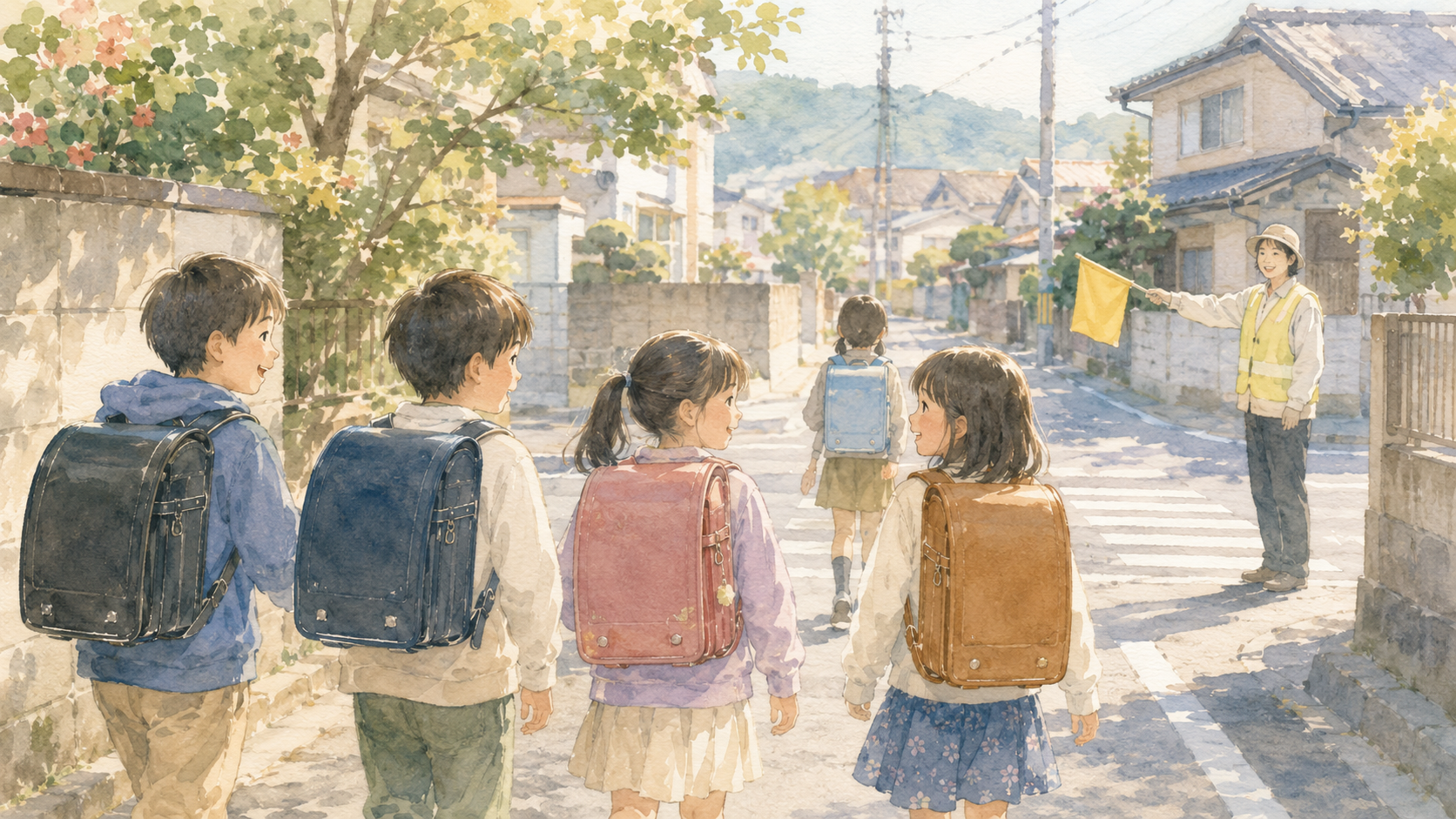
One of the first things that stops international parents in their tracks is the sight of small children walking to school with no adult in sight. In Japan, a six-year-old heading off on their own — or in a little group of neighborhood kids — is completely ordinary. If your child is about to start elementary school here, it helps to know how this actually works, what your role as a parent is, and the few times an adult does step in.
The Norm: Kids Get Themselves to School
From the first day of first grade — at age six — Japanese children are expected to get to and from school without a parent. No one drops them at the gate by car, and parents don't wait outside at the end of the day. Children walk, usually within a set school district close enough to reach on foot, and the walk is treated as part of growing up rather than a risk to be managed.
This isn't the school pushing children out the door unprepared. It rests on a whole background of things — short neighborhood-based school districts, low crime, drivers used to watching for kids, and a community that quietly keeps an eye out. We'll come back to why it works near the end.
Group Walks (集団登校) — Common but Not Universal
In many areas, children don't walk in alone in the morning — they walk in a 集団登校 (shūdan tōkō), a group walk. Kids from the same neighborhood gather at a meeting point at a set time and walk to school together in a 通学班 (tsūgakuhan, a "school-commute group"), often with an older child leading and the youngest ones in the middle.
Two things surprise international parents here:
- It's organized by the neighborhood, not just the school. The groups, meeting spots, and times are often arranged by the local residents' association or the PTA, and you'll be told which group your child belongs to.
- It's not the same everywhere. Group walks are common but have been slowly declining — fewer children per neighborhood, school mergers, and narrow busy roads where a large group is actually less safe have led some areas to drop them. Plenty of schools have children walk individually or with a friend or two from the start.
So don't assume either way. When your child enrolls, ask the school (or a neighbor with kids) whether there's a group walk, where it meets, and at what time. See our school enrollment guide for the steps before day one.
Coming Home Is Usually on Their Own
Even where mornings are done as a group, the afternoon is often different. Because children in different grades finish at different times, the tidy morning group usually doesn't reassemble for the trip home. Younger children may be sent home in small clusters heading the same way for the first weeks, but before long most kids walk home individually or with whichever friends happen to be leaving at the same time.
For a new parent this can feel like the biggest leap — your first-grader letting themselves back into the house in the afternoon. Walk the route with them many times before school starts so it's completely familiar, and agreeing on what they do when they get home.
When Adults Do Step In
The independence has clear exceptions. There are specific situations where the school switches to a supervised model, and it's good to recognize them:
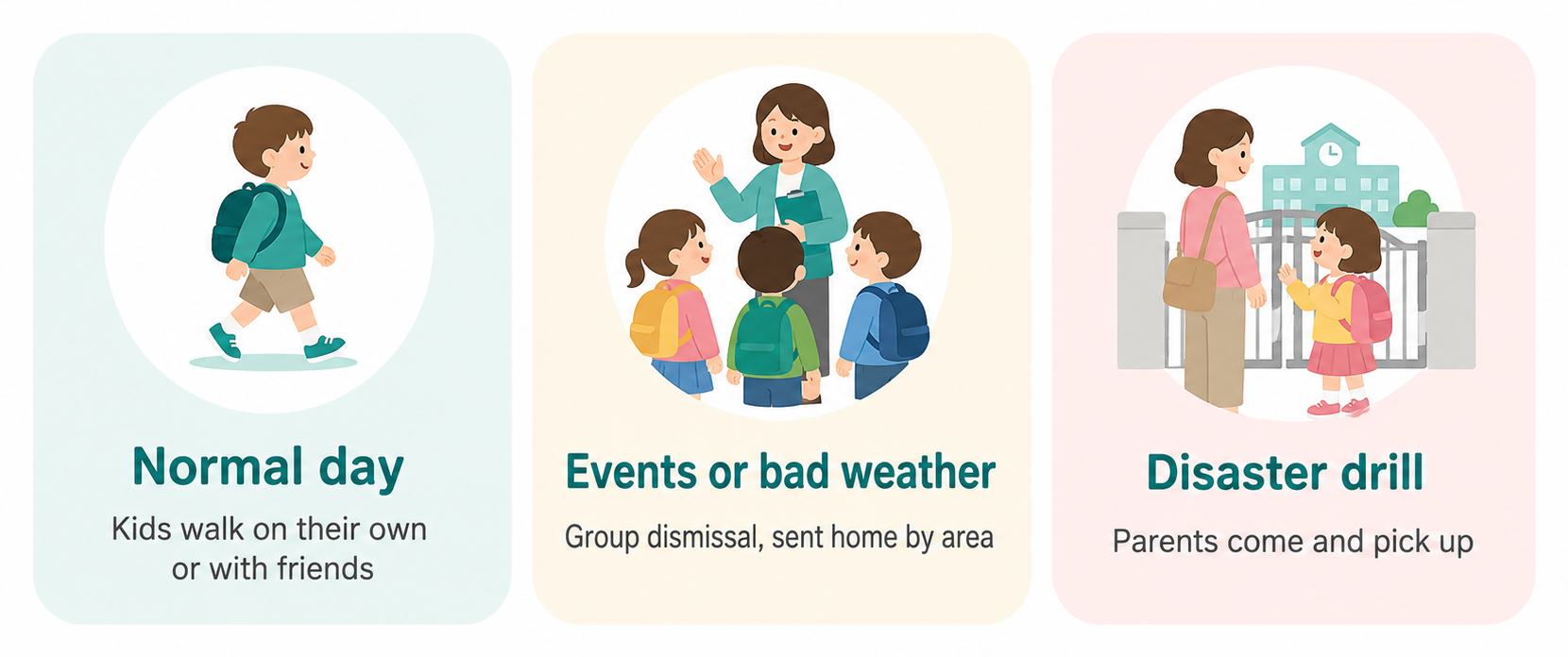
Group dismissal (集団下校, shūdan gekō)
On certain days the whole school is sent home together by area, with teachers seeing groups off — for example during bad weather, after a local safety incident, or at the end of special school events. Children are sorted by the direction they live and walk out in supervised groups. You may get a notice when this is planned.
Parent pickup drill (引き取り訓練, hikitori kunren)
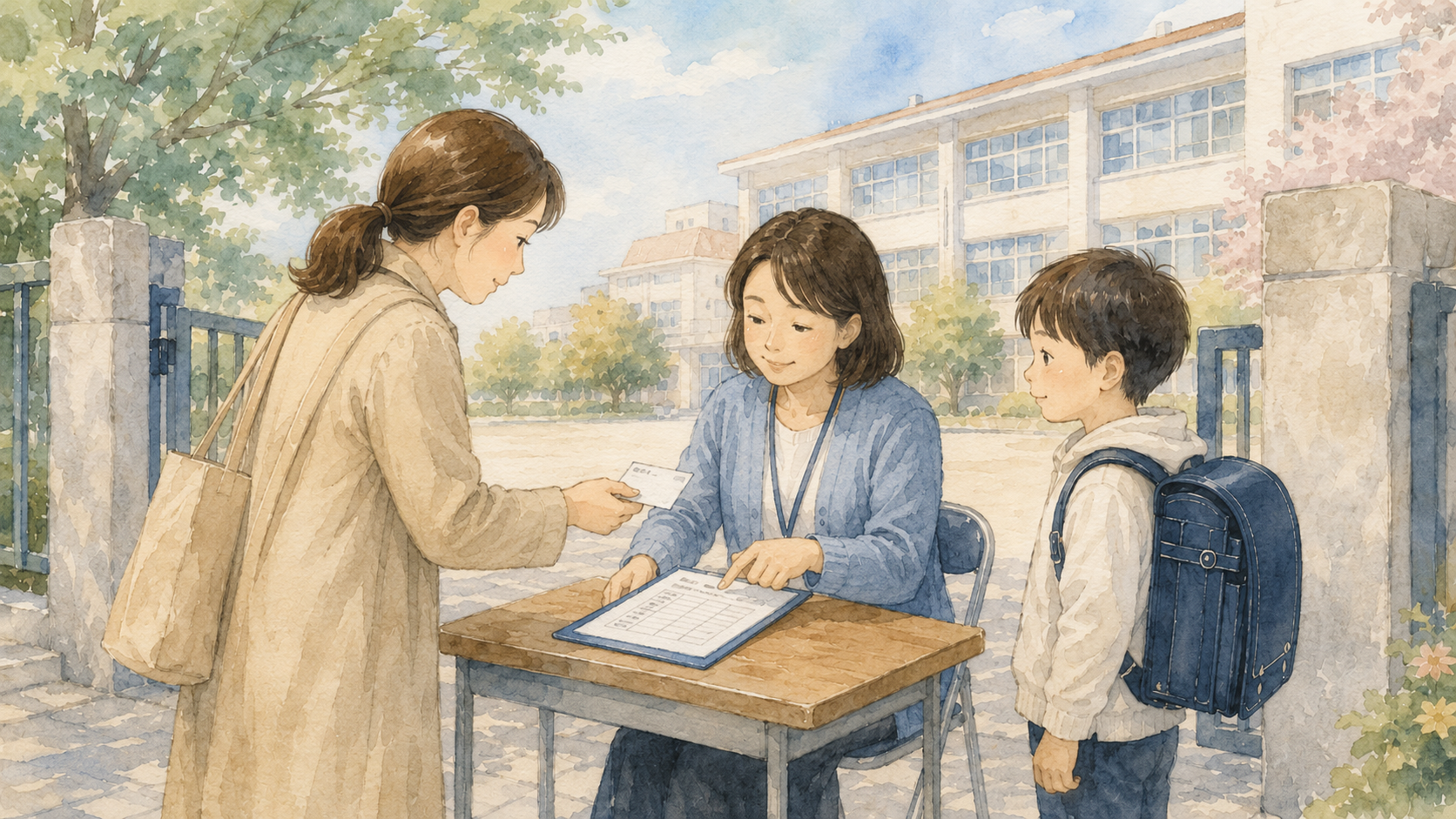
Once a year — often around 防災の日 (Disaster Prevention Day, September 1) — schools run a 引き取り訓練 (hikitori kunren), a practice for a major disaster in which children can't safely go home alone. Parents come to the school and formally collect their child. The handover is deliberate: you give your name, the child's name, and your relationship, and the teacher checks it against a pickup card (引き渡しカード) you registered in advance, so a child is only released to a pre-approved person. You'll get a letter with the date, your time window, and who is allowed to pick up. Treat it as a real appointment — it's one of the few school days you may need to leave work for.
Your Role as a Parent
"Children go alone" doesn't mean parents do nothing. The safety of the walk is partly built by the parents themselves, on a rotation:
- Flag duty (旗当番, hata tōban). On your assigned mornings, you stand at a set corner or crossing with a yellow flag, stopping traffic and helping children cross safely — usually for about half an hour around the start of school. The rotation is shared among families and comes around a few times a year; the school or PTA tells you your dates. If a child is hurt on the walk itself, that counts as being under school supervision and is covered by the school accident program.
- Watch-over volunteers (見守り, mimamori). Beyond parents, many neighborhoods have local volunteers — often retired residents — who stand along the route in vests with a flag or whistle. Some cities register them as スクールガード (school guards) and lend them armbands and gear.
- Confirm the details early. Meeting point, group or not, flag-duty rotation, what to do on a day your child is sick and won't join the group walk — these are the practical things to nail down in the first weeks.
Why It Works — and How to Prepare Your Child
It's fair to be uneasy at first. What makes it workable in Japan is a stack of things layered together: compact school districts so the walk is short, genuinely low crime, drivers who expect children on the road, the flag-duty and volunteer network above, and a shared sense that looking out for local kids is everyone's job.
None of that means you skip preparation. The children who do this well were taught, step by step:
- Walk the route together, many times, in both directions, until your child could do it half-asleep. Point out where to cross and where not to.
- Practice the crossings and the rules — stop at every curb, hand up when crossing, wait for the light.
- Agree on what to do if something's off — where to go for help, which shops along the way are safe to duck into, what to do if they miss the group.
- Kit them out. Most children carry a 防犯ブザー (bōhan buzā, a personal safety alarm) clipped to their randoseru. GPS trackers are less universal — still a minority, but a growing one, and a few city governments have started subsidizing them. If you want your child to carry one, check your school's policy first, since not every school allows them.
Done this way, the walk stops being something to fear and becomes what it is for Japanese families: a small daily dose of independence that children grow into. For what the school year itself looks like once they arrive, see our guide to elementary school in Japan.
Japanese Vocabulary
| Japanese | Reading | Meaning |
|---|---|---|
| 集団登校 | shūdan tōkō | Group walk to school, in a neighborhood group |
| 通学班 | tsūgakuhan | The neighborhood group of children who walk to school together |
| 集団下校 | shūdan gekō | Group dismissal — the whole school walks home together by area |
| 引き取り訓練 | hikitori kunren | Yearly drill where parents come to school to collect their child, for disaster preparedness |
| 引き渡しカード | hikiwatashi kādo | Pickup card registered in advance, listing who is allowed to collect the child |
| 旗当番 | hata tōban | Parents' rotating "flag duty" guiding children across crossings |
| 見守り | mimamori | Watching over children on the route — by parents and local volunteers |
| 通学路 | tsūgakuro | The designated route children take to school |
| 防災の日 | bōsai no hi | Disaster Prevention Day (September 1), when pickup drills often happen |
| 防犯ブザー | bōhan buzā | Personal safety alarm many children clip to their backpack |