
Written and reviewed by Susumu
Born and raised in Japan · Checked against Japanese law and ministry guidance
A season-by-season map of the Japanese daycare year — entrance ceremony, summer festival, sports day, recital, graduation — showing which events families are expected to attend and which just happen.
Affiliate Disclosure: This article contains affiliate links. If you click a link and make a purchase, we may earn a small commission at no extra cost to you. We only recommend products we genuinely believe are helpful. See our Terms of Use for full details.
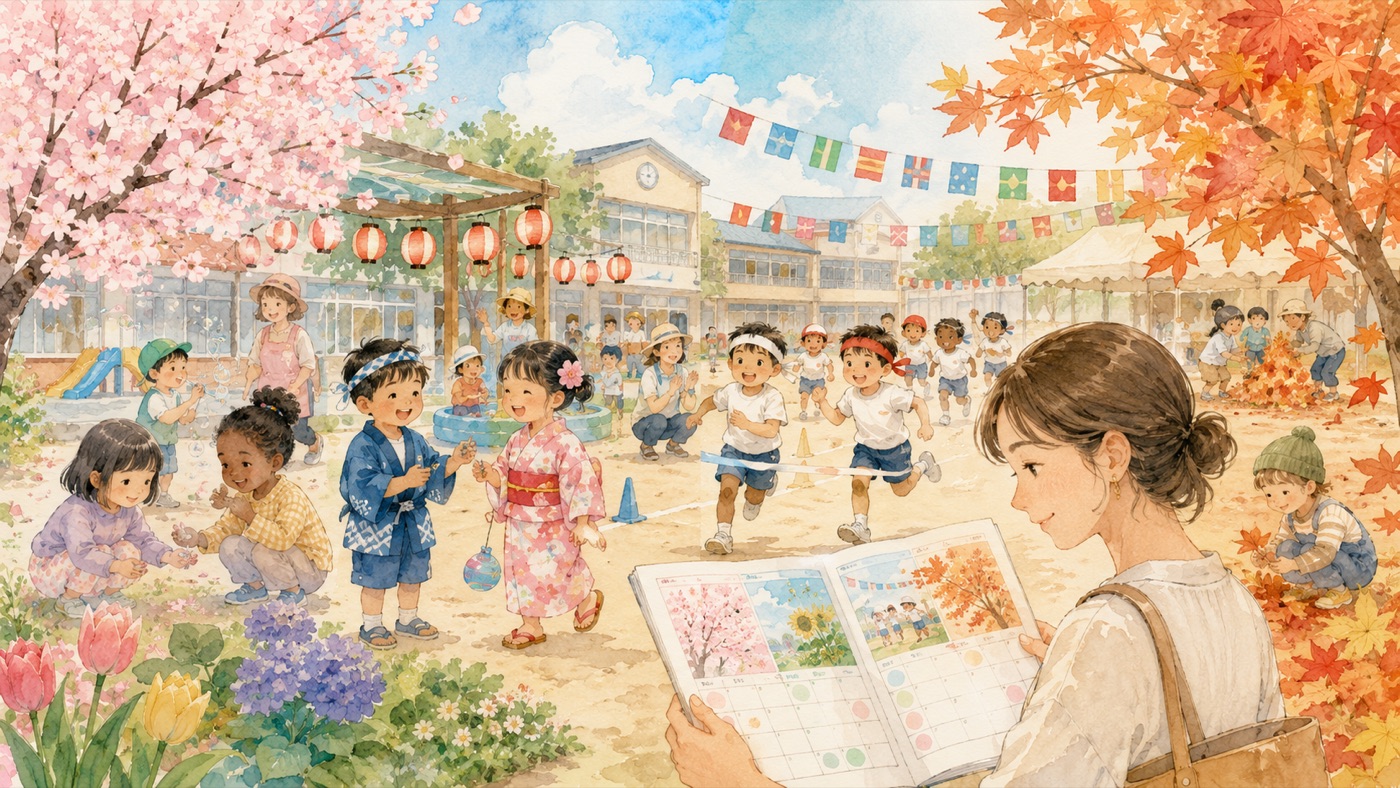
The annual schedule comes home in April, and it's full: an entrance ceremony, a summer festival, a sports day, a recital, and a dozen smaller events you've never heard of. Japanese daycare (保育園, hoikuen) packs the year with 行事 (gyōji) — seasonal events — and for a parent new to the system it can be hard to tell which ones you're expected to show up for and which just happen during the day. Here's the daycare year laid out month by month, so you know what's coming and what each one asks of you.
How the Daycare Year Is Built
The daycare year runs from April to the following March, the same calendar Japanese schools and companies use. April is when new children start and everyone moves up a class, and March is when the oldest children graduate and head to elementary school. Everything in between hangs on the seasons.
It helps to split the events into two kinds, because they ask very different things of you. Most are day-to-day events the children do among themselves — a Tanabata display, a potato dig, a bean-throwing at Setsubun — and you'll usually only hear about them through photos or the renrakuchō afterward. A smaller number are events the family attends, and these are the ones to guard in your calendar: the sports day and the year-end recital above all. Knowing which is which saves you from either missing a big day or taking time off for one you didn't need to. For how a normal, non-event day is structured, see our guide to the daily routine at hoikuen.
One thing to hold loosely: no two daycares run the same calendar. The events below are the ones you're most likely to meet, but which a given center holds, and in which month, varies a lot — a sports day can fall in spring at one place and autumn at another. Treat this as the shape of the year, not a fixed schedule, and watch your own daycare's schedule for the dates that count.
The Year at a Glance
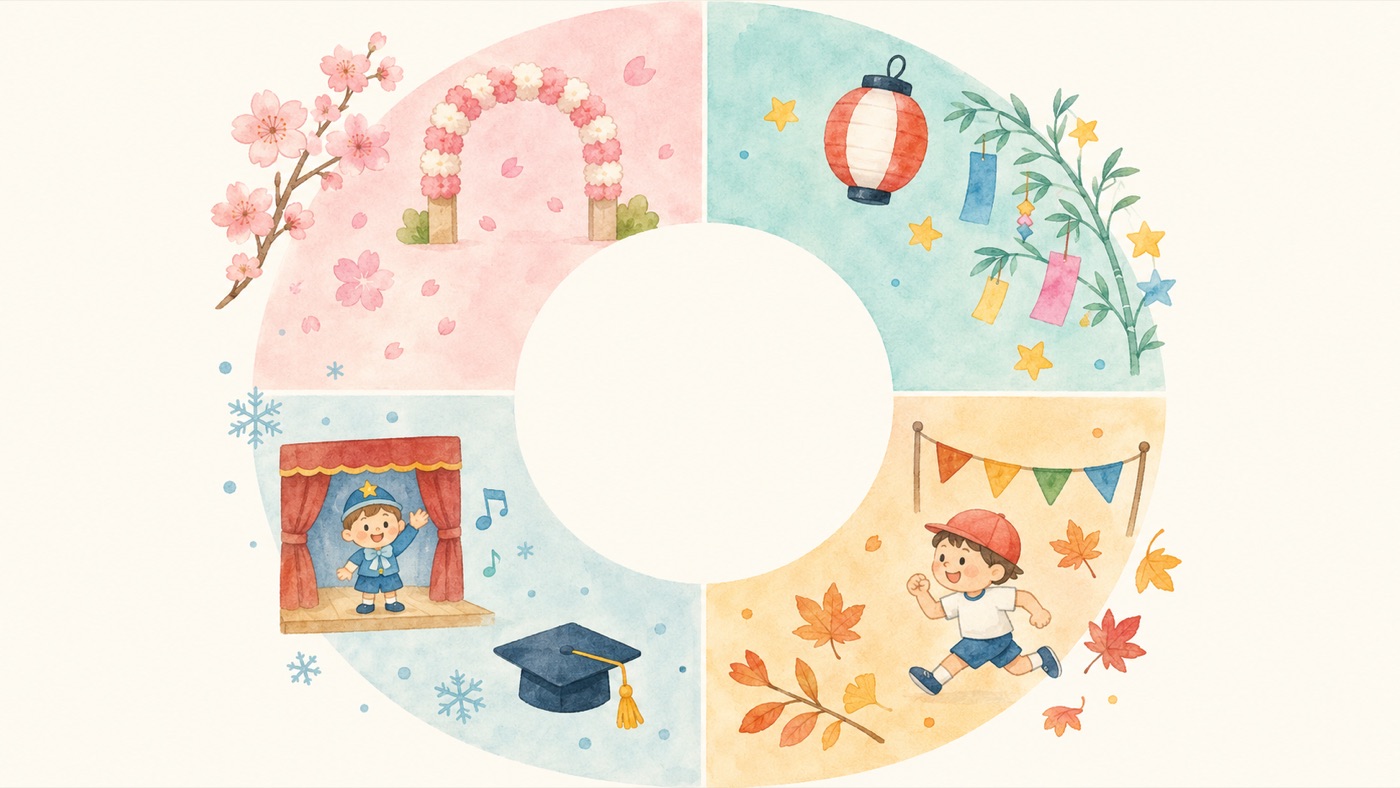
Here's the typical arc of the year, grouped by season. The biggest family-attended events are marked so they stand out from the rest.
| Season | Main events |
|---|---|
| Spring (Apr–Jun) | Entrance ceremony ★, moving-up day, parent–child field trip ★, class observation ★, spring health checkup |
| Summer (Jul–Aug) | Tanabata, summer festival ★, water and pool play, overnight stay for the oldest class |
| Autumn (Sep–Nov) | Sports day ★★, excursion, potato digging, autumn health checkup |
| Winter (Dec–Mar) | Recital ★★, Christmas party, rice-cake pounding, Setsubun, Hinamatsuri, graduation ★ |
★ family attends · ★★ the big two — plan around these.
Running quietly under all of it are the monthly regulars that aren't really "events" but shape the rhythm: a birthday celebration for that month's children (誕生日会), an evacuation drill (避難訓練), and a height-and-weight measurement (身体測定). You'll see these noted on the schedule every month.
Spring (April–June)
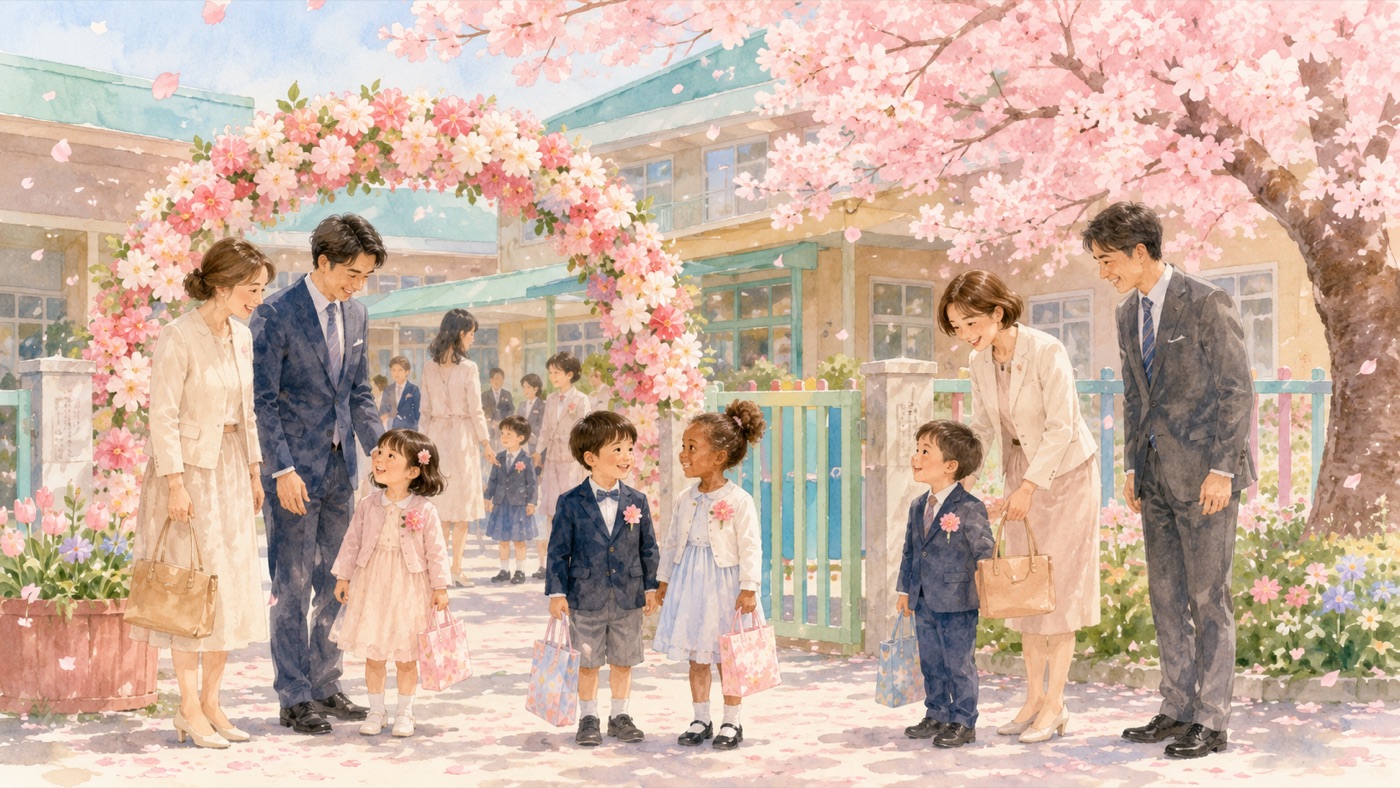
The year opens on its most formal note. The entrance ceremony (入園式, nyūenshiki) welcomes the new children in early April, and it's a dress-up occasion — parents in neat, semi-formal clothes, children in their best. On the same rhythm, the children already enrolled move up to their new class. If your child is starting for the first time, the first couple of weeks are usually a phased settling-in period; we cover that separately in our guide to narashi hoiku, the adjustment period.
Once the term settles, spring brings the first events families join. The parent–child field trip (親子遠足, oyako ensoku) is a relaxed outing to a park or zoo where you and your child go together — a good chance to meet other families early in the year. Many centers also hold a class observation day (保育参観, hoiku sankan), when you watch, or sometimes join in, an ordinary morning to see how your child spends the day. Spring is also when the health checkup (健康診断) happens, with a doctor and dentist visiting the center. For a fuller picture of the field trip, see our guide to oyako ensoku.
Summer (July–August)
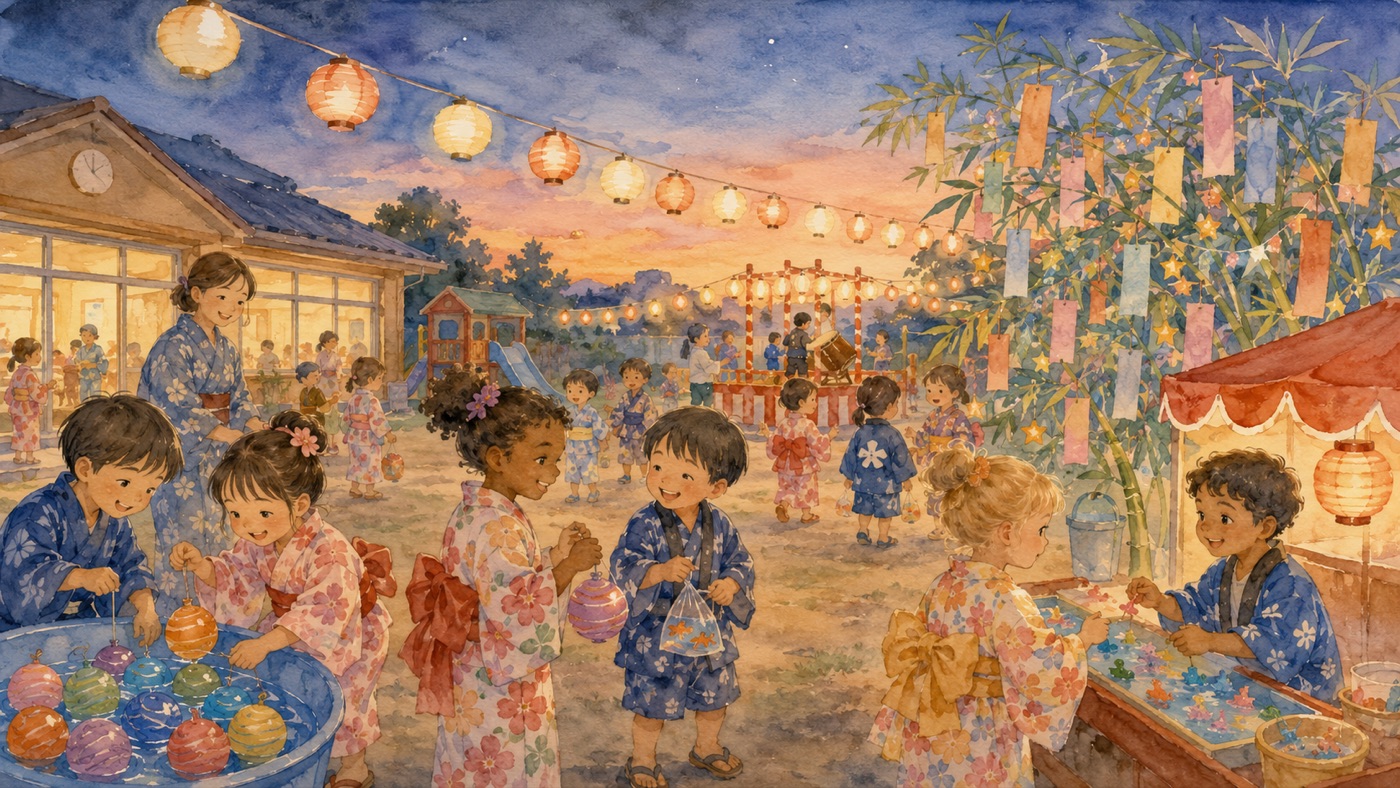
Summer is the season of small, sensory events. Early July brings Tanabata (七夕), the star festival, where children write wishes on paper strips and hang them on bamboo branches. The centerpiece is the summer festival (夏祭り, natsu matsuri) — often held in the early evening so families can come, with children in light cotton yukata or happi coats, game stalls, and dancing. It's one of the warmer, more social evenings of the year.
Through the hot weeks the children do a lot of water and pool play (水遊び・プール遊び) in the yard, which is why daycares ask you to pack a swimsuit, towel, and sometimes a signed daily card confirming your child is well enough to join. For the oldest class — the five-year-olds in their final year — some centers hold an overnight stay (お泊まり保育, otomari hoiku), a first night away from home as a group, which is a milestone in its own right.
Autumn (September–November)
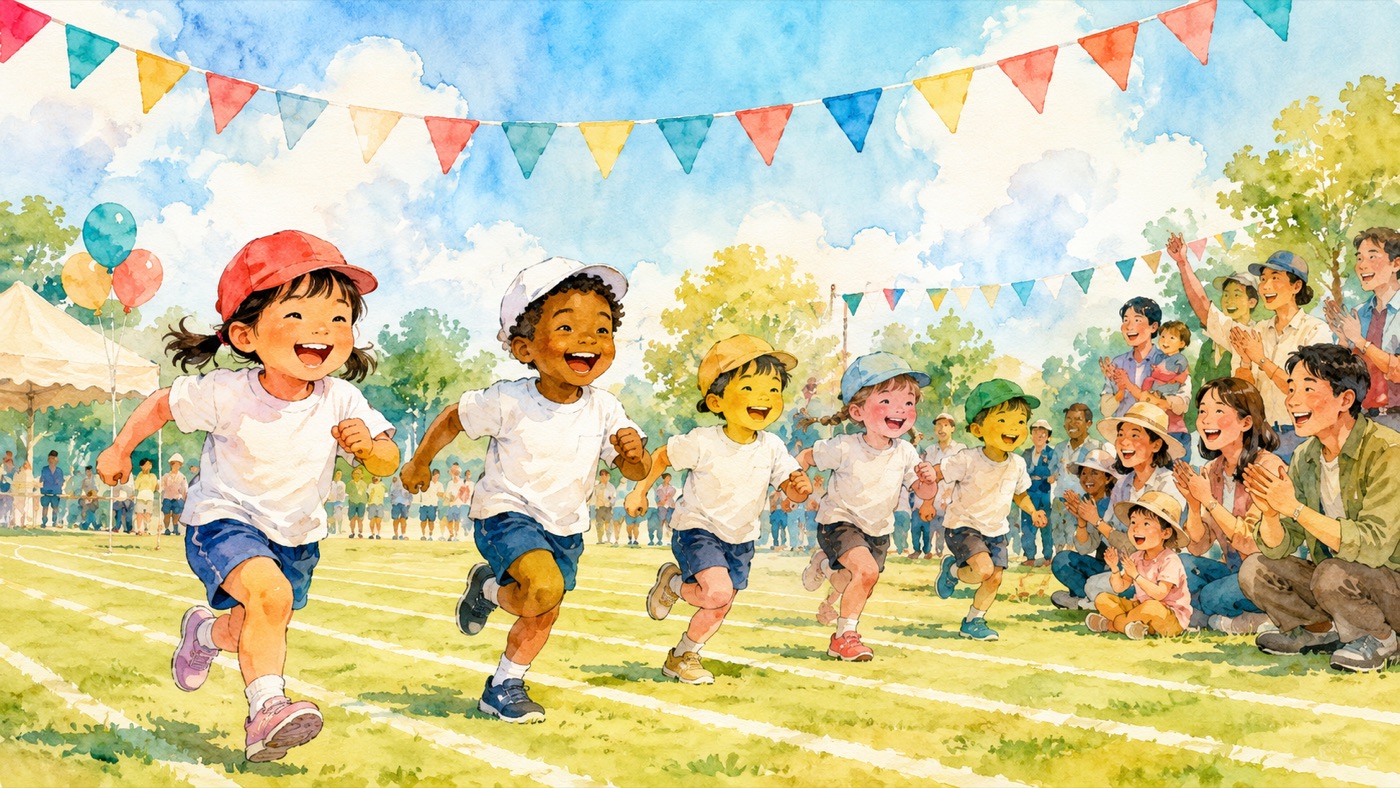
Autumn is dominated by the single biggest event of the daycare year: the sports day (運動会, undōkai). Children practice for weeks, and on the day itself families come to watch races, group dances, and simple team games, often with events where parents join in too. Spots for watching and filming fill up fast, so arrive early. (Some daycares now hold their sports day in spring instead — check which your center does.)
The season's other events lean into the harvest and the outdoors. An excursion (遠足, ensoku) takes the children out to a park or farm — this one without parents, unlike the spring trip. Many centers add a potato dig (芋掘り, imohori), pulling sweet potatoes from a field, and the second health checkup of the year usually lands here too. Send your child in clothes that can get muddy on dig days.
Winter (December–March)
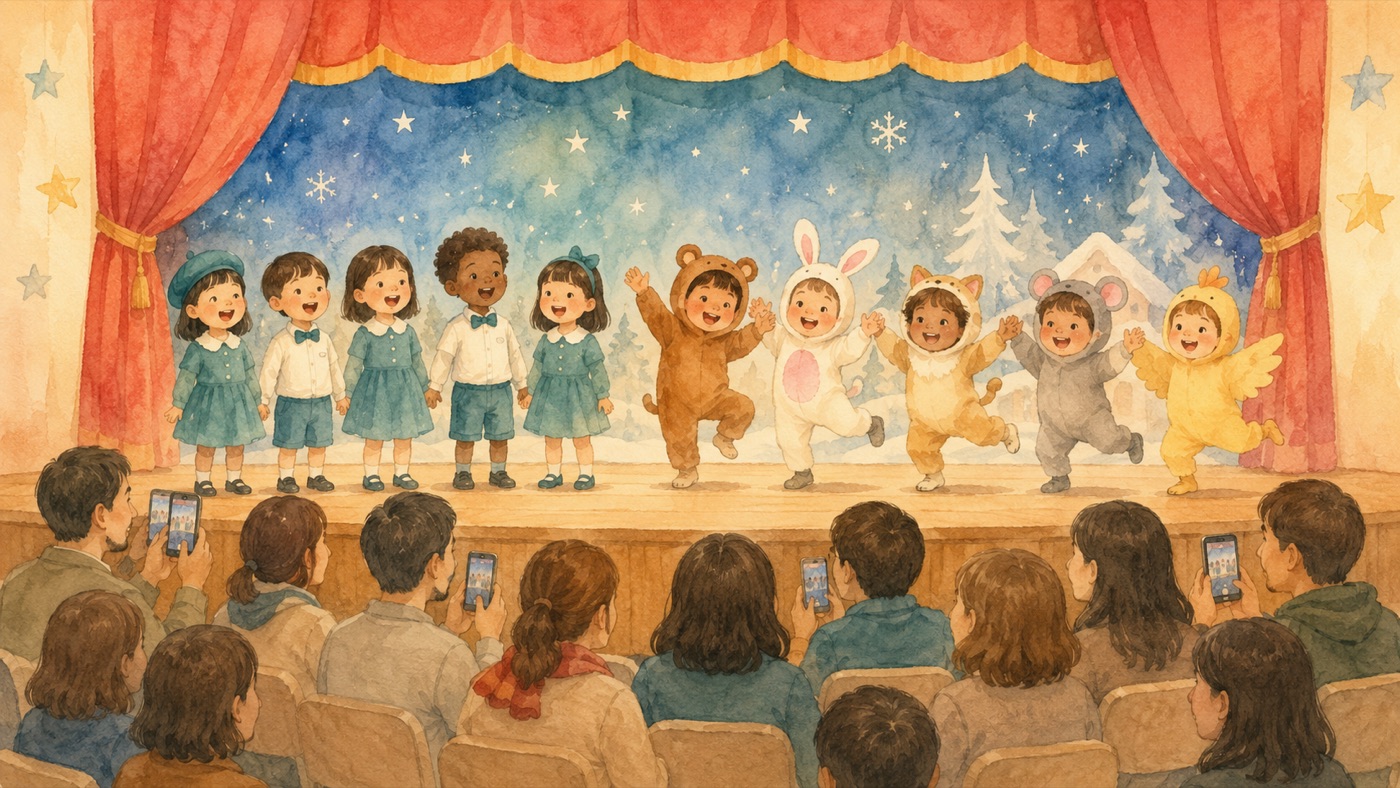
Winter carries the year's second heavyweight, the recital (発表会 / お遊戯会, happyōkai / oyūgikai), usually between December and February. Each class performs — songs, a dance, or a short play — in front of the families, and like the sports day it follows weeks of practice. This is a fixture to mark in your calendar early.
Around it cluster the winter traditions. There's often a Christmas party (クリスマス会) in December, and rice-cake pounding (もちつき, mochitsuki), where children take turns with a mallet to make mochi. In early February comes Setsubun (節分), when children throw roasted soybeans to chase off an ogre and welcome good luck, and in early March Hinamatsuri (ひなまつり), the doll festival, with a display of ornamental dolls.
The year closes as formally as it opened. The graduation ceremony (卒園式, sotsuenshiki) in March sends off the oldest children before they start elementary school — a dress-up occasion, and often an emotional one for families who've been at the center for years. Children who are staying finish the year and move up again in April, and the whole cycle begins over.
What's Expected of Parents
Most of the year asks little of you, but the family-attended events come with a few unwritten expectations it helps to know in advance:
- Dress the part for ceremonies. The entrance and graduation ceremonies are semi-formal — think neat, muted clothing rather than a full suit for most parents. Everyday events like the sports day are casual and practical.
- Expect a little handiwork. Daycares sometimes ask families to prepare something small — a costume piece for the recital, a labeled set of items, a decorated bag. It's rarely elaborate, but it's easier when you're not doing it the night before.
- Learn the photo rules. Filming and photos are usually fine for your own child, but many centers ask you not to post pictures that show other children on social media. Watch for a note on this before the big events.
- Take note of bentō days. Some events — field trips especially — are packed-lunch days even at a daycare that normally provides meals, so check whether you need to bring one.
- Read the notices. Dates, what to bring, and drop-off changes come through the center's usual channel — a messaging app, a printout, or the renrakuchō. Events are often finalized only a week or two out, so it pays to check regularly.
None of it is as much as it first looks. Once you've been through the cycle once, the year has a comfortable rhythm to it, and the events are genuinely some of the nicest parts of daycare life. For the practical side of getting a place to begin with, see our guide to applying for licensed daycare.
Japanese Vocabulary
| Japanese | Reading | Meaning |
|---|---|---|
| 行事 | gyōji | An event on the daycare or school calendar |
| 入園式 | nyūenshiki | Entrance ceremony welcoming new children in April |
| 親子遠足 | oyako ensoku | Parent–child field trip, usually in spring |
| 保育参観 | hoiku sankan | Class observation day for parents |
| 夏祭り | natsu matsuri | Summer festival, often an early-evening family event |
| 七夕 | tanabata | Star festival in July; children hang up written wishes |
| お泊まり保育 | otomari hoiku | Overnight stay for the oldest class in summer |
| 運動会 | undōkai | Sports day — the biggest family-attended event |
| 芋掘り | imohori | Sweet-potato digging, an autumn outing |
| 発表会 / お遊戯会 | happyōkai / oyūgikai | Winter recital where each class performs for families |
| もちつき | mochitsuki | Rice-cake pounding, a year-end tradition |
| 節分 | setsubun | Early-February bean-throwing to drive off bad luck |
| ひなまつり | hinamatsuri | Doll festival on March 3 |
| 卒園式 | sotsuenshiki | Graduation ceremony in March for the oldest children |