

Written and reviewed by Susumu
Born and raised in Japan · Checked against Japanese law and ministry guidance
Almost everything you have arranged for your children runs through your municipality, and several of those arrangements are tied to living there. Cross into the next city and a school place comes with your child, while the nursery place, the child allowance and the medical card all have to be arranged again. What ends at the city line, which documents to collect before you go, and the 15-day deadline that costs real money if you miss it.
Affiliate Disclosure: This article contains affiliate links. If you click a link and make a purchase, we may earn a small commission at no extra cost to you. We only recommend products we genuinely believe are helpful. See our Terms of Use for full details.
The short version
- A public elementary school place follows your child. The new city assigns a school and you carry three documents across.
- A licensed nursery place does not follow your child. The approval behind it belongs to the city that issued it.
- The child allowance has a 15-day deadline after you move. Miss it and those months are gone.
What the City Line Does
Almost everything you have arranged for your children runs through your municipality's offices, and several of those arrangements are tied to living there. Cross into the next city and some of them come with you. Others end that day.
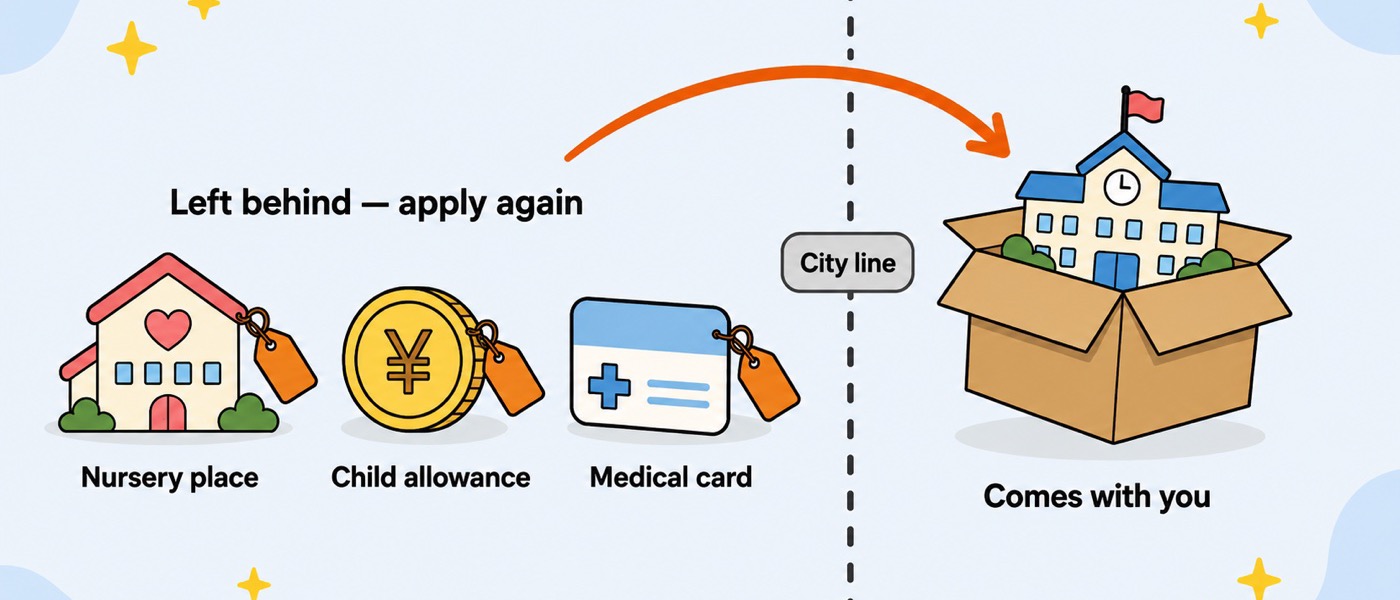
The difference catches people out because the two systems look similar from the outside. Both involve the city office. Only one of them hands your child straight to the next place.
Elementary School: Three Documents
Public elementary and junior high school is the easy one. You are not competing for a place. The new municipality tells you which school your child attends, based on your new address, and your job is to carry the paperwork from one side to the other.
This is the route for a child already enrolled in a Japanese public school. If your child has not been enrolled in one yet, our guide to enrolling in a public school covers that step instead.
Three documents matter, and two of them come from the school you are leaving:
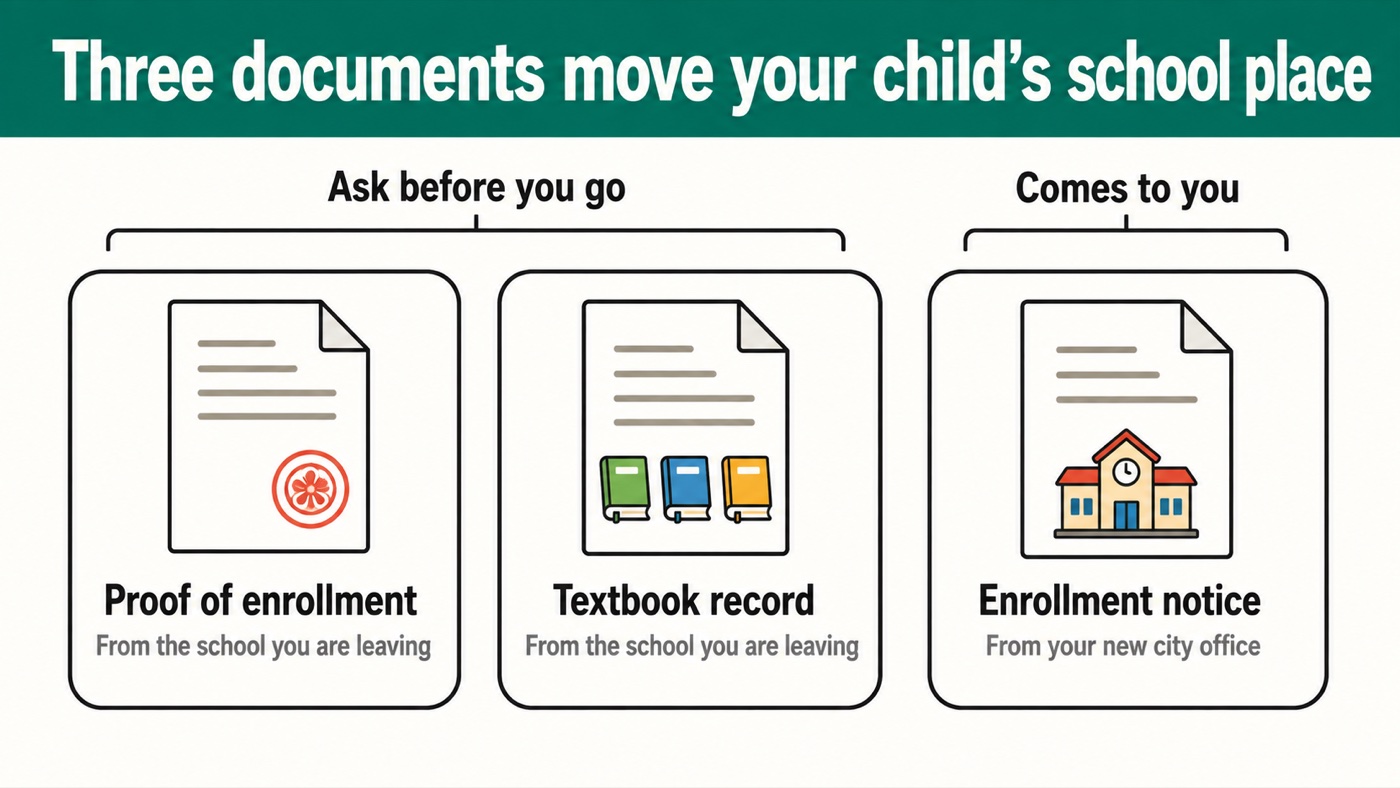
- 在学証明書 (zaigaku shōmeisho) — proof your child is enrolled. The current school issues it.
- 教科用図書給与証明書 (kyōkayō tosho kyūyo shōmeisho) — a record of the textbooks your child has already been given, so the new school issues the ones still needed. The current school issues this too.
- 転入学通知書 (tennyūgaku tsūchisho) — the notice telling you which school your child now attends. The new municipality issues it after you register your address. Some cities call it 入学通知書 instead; it is the same paper.
Tell the current school before you go, so the two certificates can be prepared.
Nursery: The Approval Stays Behind
Licensed daycare works on a different principle, and this is the part worth understanding properly.
Your child does not hold a nursery place the way a pupil holds a place at a school. What your household holds is an approval, called 支給認定 (shikyū nintei), saying that your family needs childcare.
The law puts that approval in the hands of the municipality where you live. It also says that once a family comes to live outside that municipality, the city that issued the approval may cancel it.
So the place is not yours to carry across. Whether your child can keep attending the same nursery, or get into one near the new home, is decided by the city — and in a new city you are applying alongside everyone else.
There is a route for attending a nursery in a city you do not live in. It is called 広域利用 (kōiki riyō), cross-boundary use.
National guidance is clear about who decides. The city where the nursery sits handles it, using its own rules on children from other cities, and weighing its own capacity and its own waiting list.
The guidance also lists what that city weighs: how much cross-boundary use already goes on between the two municipalities, how full its facilities are, and whether it has children waiting. So the answer depends on the pair of cities involved, not on your circumstances alone. Ask both city offices early, and ask before you sign a lease.
If you end up applying fresh in the new city, the scoring is the same machinery we describe in our guide to how nursery places are scored, and the application itself is covered in how to apply for licensed daycare.
Kindergarten Works Differently
Kindergarten sits outside all of that. National guidance says that for children in the kindergarten category, families apply directly to the facility, with no arrangement between the two city offices at all.
So the conversation is with the kindergarten rather than with a city desk, and private kindergartens set their own terms. Ask them directly whether they can take your child, and from when. Our guide to applying to a yochien covers how that goes.
The Child Allowance: 15 Days
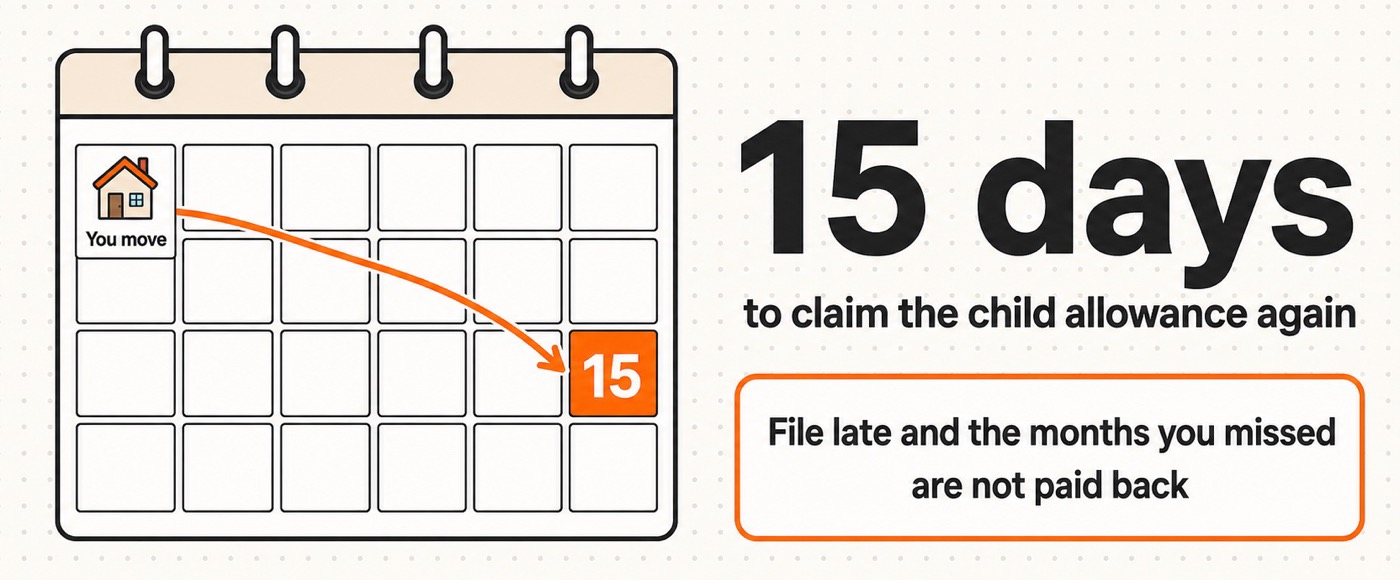
This one has a hard deadline and real money attached.
The child allowance (児童手当, jidō teate) is paid by the municipality you live in. When you move, the old city stops paying and you have to file a fresh claim in the new city. Nothing transfers on its own.
The national rule, in the Children and Families Agency's own words:
- File in the new municipality within 15 days, counted from the day after your moving-out date.
- File late and you lose the allowance for the months you were late. Those months are not paid back later.
One reassurance if you move at the end of a month. The 15 days run from your move, not from the first of the month, so a claim that lands in the following month still counts as being on time. You do not lose anything by the calendar turning over.
Put this ahead of the furniture. Our guide to benefits for raising children in Japan covers what the allowance pays.
The Medical Card Stops
The card that makes your child's doctor visits cheap or free comes from your city, not from the country. It works inside that city's system.
When you move out, the card stops being valid and city pages ask you to send it back. The new municipality will have its own version, with its own age limits and its own rules, and you apply for it there. Take your child's health insurance card with you to the counter.
Do not assume the terms match. Age limits and co-payments are set locally and genuinely differ. Our guide to the child medical fee subsidy explains how the card is used.
The Order to Do It In
Almost everything above waits on one thing: your address being registered at the new city office. So the sequence matters more than the speed.
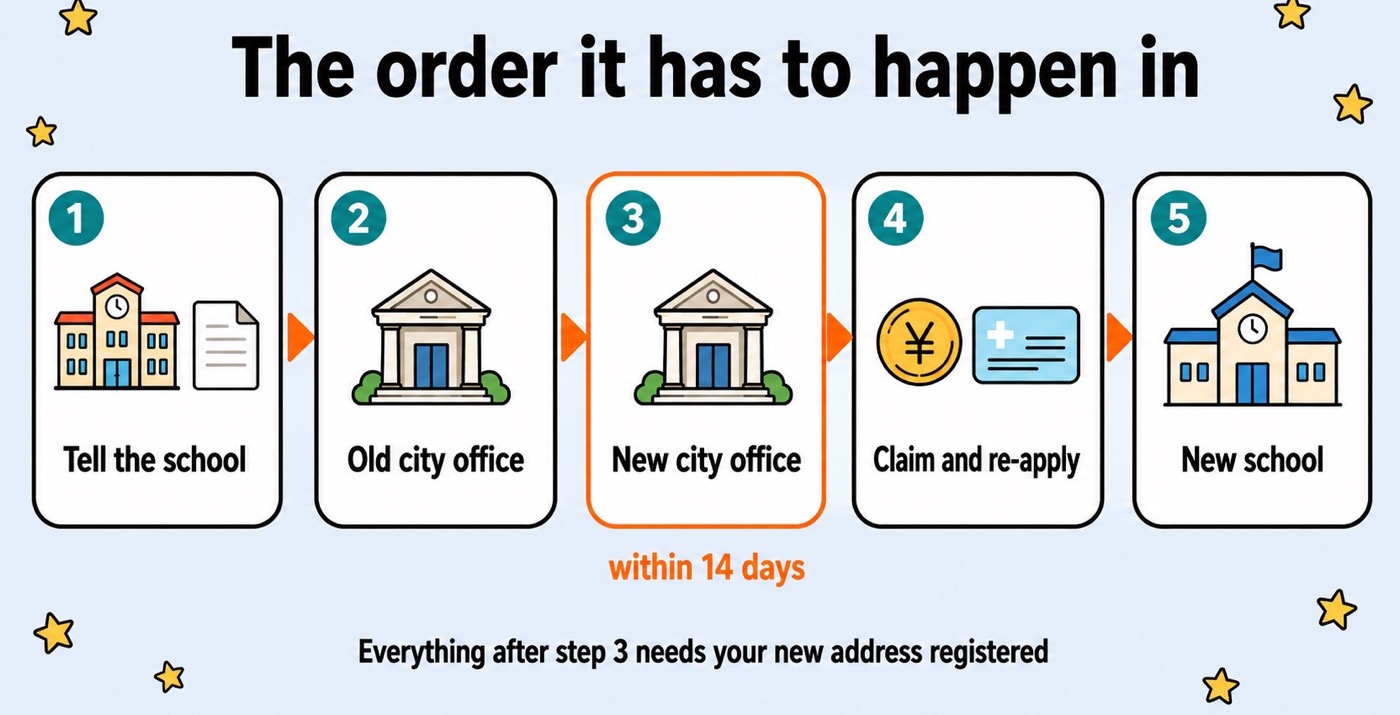
- Before you go. Tell the school, and ask for the two certificates. Ask both city offices about the nursery. Return the medical card.
- At the old city office. File the moving-out notice and take the certificate it gives you.
- At the new city office. Register your address within 14 days of moving in. If you hold a residence card, bring it — this is also where your address on it gets updated.
- Then, at the same counter or nearby. Claim the child allowance, apply for the medical card, and collect the school notice.
- At the new school. Hand over the two certificates and the notice.
Steps 3 and 4 can often be done in one visit if you arrive with the documents. If you are not sure where to start, ask at the information desk inside the entrance.
The deadlines and document names above are national. Which counter handles what, and how much can be done in one go, is each city's own arrangement, so confirm the local shape of it before you set out.
子どもの手続きは、どこの窓口ですか。
Kodomo no tetsuzuki wa, doko no madoguchi desu ka?
Which counter handles the procedures for children?
Japanese Vocabulary
The words you will see on the forms and hear at the counter:
| Japanese | Reading | Meaning |
|---|---|---|
| 転出届 | tenshutsu todoke | Moving-out notice, filed at the city you are leaving |
| 転入届 | tennyū todoke | Moving-in notice, filed within 14 days at the new city |
| 在学証明書 | zaigaku shōmeisho | Proof of enrollment, from the school you are leaving |
| 教科用図書給与証明書 | kyōkayō tosho kyūyo shōmeisho | Certificate of textbooks already issued to your child |
| 転入学通知書 | tennyūgaku tsūchisho | Notice naming the school your child now attends |
| 支給認定 | shikyū nintei | The childcare approval, issued by the city you live in |
| 広域利用 | kōiki riyō | Attending a nursery in a city other than the one you live in |
| 認定請求 | nintei seikyū | The child allowance claim, due within 15 days of moving |